Showing posts with label Last-Mile. Show all posts

Sunday, January 4, 2015

Femtocells (MicroBTS) in support of Emergency Communications

I raised a question with several on-line interest groups: Disaster Management India and Researchers and Disaster Management Professionals and Research. It was intended to understand the real value of the Femtocell (also referred to as Picocell or Microcell) technology in emergency communications. Has there been a significant uptake of the Femtocell technology in emergency communications?

Image http://tinyurl.com/oxkclcd
The technology has been around for about ten years. It was developed for commercial wireless telecom carriers to extend their coverage in locations where construction of a full size mobile tower is not warranted or economically justifiable. They are low power, short range (< 100m), and serve between 1-5 simultaneous connections. Ones made for small business or farm use can control up to about 100 users. However, they typically aren't big enough as currently sold to support a major emergency operation [1].

A small deployment, in a disaster affected area, could serve the public in small batches allowing them to reach their loved one. The Federal Communication Commission of USA has discussed the use of Femtocells as a Public Safety Tech. US telcom operator AT&T supports some mini systems that they use for their own emergency deployments and also offer to emergency management teams. The suitcase size,  bigger than Femtocells, AT&T solutions can support 500-1500 users simultaneously. Depending on the bandwidth available they do a decent job, at least with voice.
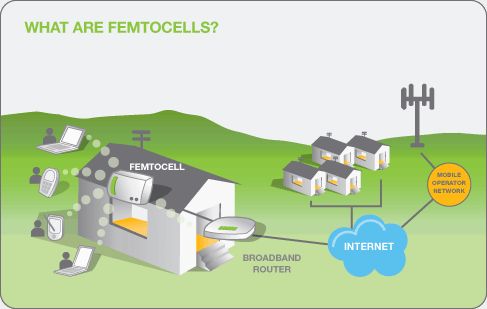
Image from EMF Explained Series: http://tinyurl.com/ovjrcot
Femtocells are Micro Base Transceiver System (Micro BTS). The mobile phone connects to a small local Femtocell device about the size of your WiFi modem as if it would to a regular GSM/WCDMA cellular tower. That device then provides voice and data to your cell phone where it otherwise wouldn't be able to pick up a signal out of the air. Cost of the device is under $100. David Kebo Houngninou explains the technicalities and architecture of setting up a cost-effective Femtocell access point.

Pasquale Pace and Valeria Loscri published on the architecture of OpenBTS as another step forward towards establishing cost-effective Micro BTS solutions. Range Networks has primarily customized the openBTS platform for a Network in a box kind of offering. They have a handful of implementations in various parts of the world: Antarctica, Indonesia, and Zambia. Folks at Daes and Orangee have discussed their practical experience of implementing a OpenBTS-enabled Microcell.

Extreme arid terrain: http://tinyurl.com/mjg3fgb
In the wake of a disaster, like an earthquake that may take out the towers and cables, it may take the telcos, at least, 48 hours to restore those BTS. The earthquake may cause landslides that may block the roads for Cells on Wheels  (COWs) to reach the cellular dark area. Some areas can be unmotorable in  terrain with high mountains, deep valleys, rocky ground, and swampy lands. A Mobile Emergency Operation Centre (MEOC), similar to the DUNE2014 project with LTE broadband capable of transmitting video data, can be setup at a distance. Then the MEOC can extend the LTE internet connection to serve the Public at a distant location by linking them to a Femtocell.

Of cause there are legalities with frequency reuse by an unlicensed service provider. There must be roaming agreements between providers to use the same frequencies in the same area; i.e. multi-carrier compatibility to allow for a femtocell to communicate with handsets from different carriers. It doesn't affect or matter who's at the other end of the line. Government agencies have the authority to overpower those licensing barriers. A Micro BTS setup by a Government emergency service can certainly override those licensing issues. Another option is to offer a set of emergency frequency bands that any authorized service operator can use to operationalize a Micro BTS in the time of an emergency.

The back-haul can simply be a broadband (internet) link to pipe the cellular signal. For example, a VSAT connection can serve as back-haul in a cellular dark area caused by a disaster . However, one must be cautious of the latency that comes along with satellites back-haul. Moreover, it has to have some form of authentication to interface and establish routing of the call in both directions. Establishing a satellite link in between would likely fail because of latency and technical routing problems. Mobile phones require specific performance characteristics that are not one size fits all that can be accommodated by one system.

While Femtocells have certain challenges with operationalizing that are mainly due to policy and regulatory issues, it still is a promising technology for serving the gaps of filling the dark cellular coverage holes in support of crisis response and management.

Acknowledgement

My gratitude to the following people (listed in alphabetical order) for their contribution to the discussion that resulted in this blog


[1] Disaster Researchers and Disaster Management Professionals, LinkedIn Group. "Femtocells, who uses them?", consulted on the web: https://lnkd.in/dgBUmcC

[2] Disaster Management India, LinkedIn group. "Femtocells, who uses them?", consulted on the web: http://tinyurl.com/n6oroge

Wednesday, February 1, 2012

Sahana Google Code-In Students work on CAP Broker

Once again Sahana participated in 2011 Google Code-In. Happy to have been part of it mentoring students. A big thrill was that they worked on the few research tasks that were related to the Common Alerting Protocol (CAP) Broker. The two main tasks were:
  1. develop a blueprint with wireframe to port the Sahana Agasti CAP Broker to Sahana Eden (because Sahana Agasti CAP Broker is no longer supported by the community; moreover, the new version that will be built in to Eden would build on the lessons learned and improve the shortcomings from the piece-wise build original version)
  2. develop a wireframe to build an XSL Editor (mainly to develop XSL files to transform full CAP messages to deliver through short-text, long-text, and voice-text messages through email, SMS, IVR, Twitter, etc)
The CAP Broker is a tool that I have been researching on and developing over the past six years. The real need of a CAP Broker is in early warning. Based on the systems definition for early warning system, it requires a Broker to acts as a messaging pivot between those who publish alerts/warnings and those who subscribe to them.

The first works were with the HazInfo project, when we tested various wireless technologies for their ability to carry CAP messages to last-mile communities. There was an opportunity to further develop and test it for cyclones and hurricanes but we failed to win the hearts of NSA to nail the grant. There was also interest to build the libraries and test components that would carry CAP messages over Radio Data Systems; however, could not secure any funding to try this as well.

What we did achieve was testing CAP over HF data platform. The first working Sahana CAP broker was tested for health alerting with delivery over HTTP, Email, SMS, and RSS. Then recently, the field testing of CAP messages disseminated through an IVR.

STANDBY ... There's more work to be done and shared.

Saturday, August 16, 2008

Audio content production and delivery is the first step to instigating citizen journalism

Since October 2007, I have been voluntarily engaging in building capacity within Sarvodaya with the intent of mobilizing rural communities in developing local content. If we are to divide content as text, audio, and video, the question is "which one of the mediums do we start with first, in a Sri Lanka?"

We can rule out video based on cost of production and need for professionalism. Similarly, the production and distribution of text; i.e. a newsletter, would be rather costly and would be hard to recover the costs from the subscribers. In general Sri Lankan people are less inclined to reading and writing; i.e. even in a long distance bus one would observe nearly zero people to read a book or a news paper. However, would be apt to listening to the bus radio or even their built in FM radio on the mobile phone. Therefore, Sarvodaya policy was to use audio as a medium to instigate the concept of citizen journalism within its mandate.

My belief is developing audio, which is as simple as pressing the record button and speaking one's mind in to a microphone is far more simpler than electronically composing a story or making a video that is meaningful. Moreover, delivery of audio requires much less bandwidth opposed to video.

The community based audio production and delivery concept was presented to an audience at LIRNEasia by my colleague Chamindha Rajakaruna to get an opinion on the foreseen strategy. The real-time blog on the colloquium titled "Sarvodaya satellite and web radio, a precursor to community-radio, the way forward and challenges" highlights the concept. The colloquium was valuable to us in seeing the way forward; especially in separating the tow intents: 1) Internal closed user group broadcast of content on Sarvodaya philosophy, governance, and activities 2) pure citizen journalism creating a platform for people to voice their opinions and exchange ideas. I have written a comment on the LIRNEasia blog under the same colloquium topic saying that in a country where broadband in rural areas is still in its infancy an alternative broadcast technology and a peer-to-peer technology are both necessary, if Sarvodaya is to achieve intentions 1) & 2).

This community based audio content production and delivery project is a spin off from the past HazInfo project, which concluded the need for both the WorldSpace addressable satellite radios for emergency alerts and Dialog/Microimage Java enabled mobile phones for SMS alerts as the two technologies that could provide complementary redundancy in a closed user group last-mile hazard warning system. While mobile phones have been embraced in to the daily lives of people in Sri Lanka, the WorldSpace satellite radio remains a new and unheard information communication technology in Sri Lanka. Therefore, the greater challenge is developing a sustainable platform for the satellite radios as a technology that is always used. Deshodaya Media Production Unit took on the challenge of developing connect through a community participatory approach to bring life to the channel dedicated to Sarvodaya.

Given that the satellite radio and mobile phone technologies are currently in operation, it is ideal to use these two technologies as basis to test the content production and development processes such that when broadband with internet is widely accessible in rural Sri Lanka, the citizens would have the know how to develop MP3 audio content for exchanging information.