


In several blogs I've mentioned my work in relation to Common Alerting Protocol (CAP) a standard that is being absorbed by emergency communicators for exchanging situational reports in relation to natural and man-made threats. Past month I was in Sri Lanka, predominantly, attending to field work on the real-time biosurveillance program, my current ongoing project, which is using CAP for issuing health alerts (situational reports) to health workers. During this visit I was invited by CEL Lanka to review their home brewed Radio Data System (RDS) for issuing text alerts over FM radio waves.
The RDS for alerting comprises a special FM radio developed by CEL Lanka that can receive text to display as well as turn on an audible siren according to a priority level, a larger LCD display to be assemble in public spots such as bus stations, road side, trains, etc, and a software module to communicate with the encoder for generating text messages in Sinhala, Tamil, and English languages. This project had been funded by the Information Communication Technology Agency of Sri Lanka (ICTA) under a small grant. CEL Lanka has produced 40 of the LCD units to be deployed in location around the Island.
I recommended that the system incorporate CAP for value addition; more so for being CAP compliant to receive a CAP message and automatically feed the required data to the RDS text element. This way the system can be easily plugged in to any existing Disaster Communication Software system without too many changes such as a P2P CAP Broker. Similar to SMS alerts or Email alerts one can include RDS as another medium for receiving alerts.
CEL Lanka is interested in enabling the system with CAP. We will include the RDS as a plug in to the Sahana Messaging Module. Another similar project is the inclusion of a gateway to send and receive text over HF Radios being developed by Universiti Teknologi Malaysia (UTM). Respere Lanka developed the SMS/Email engine for issuing text alerts. Respere will come in as a partner to develop the web browser based GUI to trigger CAP alerts to be transported through the RDS.
Similar to SMS, RDS also has limitations on the number of characters that each packet can carry. Concatenation of packets pose the same problem as SMS pages; where packets/pages not arrive in the same sequence they are sent. These are some of the few challenges that lie ahead in delivering this component. Over the next few weeks I will be working on the software architecture and the CAP profile for including the RDS in to the Sahana Messaging Module. We intend to apply for a small grant to produce the remaining components.

Friday, February 27, 2009
Friday, December 5, 2008
Short Messaging and Common Alerting Protocol over HF Spectrum
 Amateur radio operators have played a major role during disasters in providing front line communication when all other technologies have seized to operate. MARTS - Malaysia Amateur Radio Transmitter's Society was in full force sharing their experiences and demonstrating the equipment at the ITU Asia-Pacific Centers of Excellence Training Workshop on Effective Use of Telecommunication/ICT in response to disasters: saving lives. The equipment range from vehicle mounted, hand helds, and nomadic units that work over UHF/VHF/HF frequencies. I had the privilege of presenting the Common Alerting Protocol experience in Sri Lanka to the government delegates from Asia and the Pacific Islands; CAP was unheard of by the delegates.
Another novel project on the use of HF spectrum for communicating short messages (or chat messages) was presented by Prof. Dr. Ahmad Zuri bin Sha'ameri at the same ITU event. It was definitely a product that could be engulfed in to the Sahana suite of Messaging gateways or part of the P2P CAP Broker. Both him and I got off to a good start on agreeing to proceed with the experimental idea of porting his solution on to Sahana. An initial document of the concept and action plan was exchanged within a few days of us returning to our desks.
Most of the officials attending the ITU event were officials from their respective telecom regulatory bodies working on disaster management. They were quite excited of the project we have put on the table and promised to educate their ministers of the possibility of piloting the HF spectrum text messaging modules for emergency communication in their countries.
The first step is to develop the software and prove the concept in Malaysia and/or Sri Lanka. This portion of the project is being funded by the Malaysia Communication and Multimedia Commission. Second step is to write a larger proposal to pilot the working solution in Sri Lanka, Malaysia, and few of the Pacific Islands - Nauru, Marshal Islands, Vanuatu, etc.

Wednesday, November 19, 2008
Optimally transporting XML through SMS for CAP Messages - How can it be done?
While working on my presentation titled "Common Alerting Protocol" (CAP) for the ITU Workshop in Kedha, Malaysia and experimenting with the Sahana Messaging/Alerting Module in preperation for a demo for the workshop participants, I questioned, "is there a method already in place or how does one optimally send an XML file through the SMS transport. Of cause this is in relation to transporting a CAP message with the underlying XML data storage and transfer standard through the SMS transport technology.
One would say, "why bother with SMS just transport it through GPRS or any other advanced mobile data service platform transport layer. There are advantages that SMS offers and GPRS does not; a key advantage being SMS is always ready to receive messages (i.e. data can be pushed on to) provided the handset is turned on; where as GPRS must be user initiated where the data must be pulled. For the purpose of "alerting" SMS surpasses GPRS with the mentioned advantage. It is also possible to house a an applet that resides on the handset and uses GPRS to periodically fetch newly posted WAP alerts.
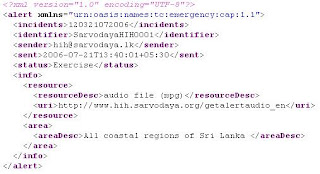
Obviousely all one needs to do is insert the XML formatted text including the tags, header, etc in an SMS text and send it to whomever they want. The dilemma is in the payload. The XML formated text in the image above has 520 characters with white space and 421 characters without white space. The 520 characters would fit in to four 8-bit encoded SMS pages. Cost of an SMS is proportional to the number of SMS pages; unlike GPRS which is billed by the number of bytes (or kilobytes). More so, the intent of CAP being mass alerting efficiency is compromized with the size of the payload. Hence the key question is "how do we minimize the payload of a CAP message transported througg SMS to maximize the efficiency and the effectiveness?"
For a targeted application such as one that would display a CAP message could be designed to include only the necessary and sufficient (tags), which are yet to be determined by experts and remain an open problem. Let us assume the CAP SMS text carries the <incident>, <scope>, <status>, <msgType>, <category>, <event>, <urgency>, <severity>, <certainty>, <areaDesc>, and <resourceDesc> tags. The mobile phone application would be designed to read these tags and display on an interactive mobile phone GUI. The GUI would give the recipient the option to change the predefined values such as the <msgType> from the received value of "Alert" to "Ack" and reply to the sender. Assuming the alert was issued through a software such as the Sahana Messaging Module, which has a feature to store replies and produce a consolidated report, sender could match those who had received and acknowledged the alert.
I anticipate the need to transfer XML files on to mobile phones will become a must with standardization and interoperability. The revers or the dual exists; thus XML encoding for SMS. Any one interested can find technical literature on IBM's developer works Tips.
One would say, "why bother with SMS just transport it through GPRS or any other advanced mobile data service platform transport layer. There are advantages that SMS offers and GPRS does not; a key advantage being SMS is always ready to receive messages (i.e. data can be pushed on to) provided the handset is turned on; where as GPRS must be user initiated where the data must be pulled. For the purpose of "alerting" SMS surpasses GPRS with the mentioned advantage. It is also possible to house a an applet that resides on the handset and uses GPRS to periodically fetch newly posted WAP alerts.

Obviousely all one needs to do is insert the XML formatted text including the tags, header, etc in an SMS text and send it to whomever they want. The dilemma is in the payload. The XML formated text in the image above has 520 characters with white space and 421 characters without white space. The 520 characters would fit in to four 8-bit encoded SMS pages. Cost of an SMS is proportional to the number of SMS pages; unlike GPRS which is billed by the number of bytes (or kilobytes). More so, the intent of CAP being mass alerting efficiency is compromized with the size of the payload. Hence the key question is "how do we minimize the payload of a CAP message transported througg SMS to maximize the efficiency and the effectiveness?"
For a targeted application such as one that would display a CAP message could be designed to include only the necessary and sufficient (tags), which are yet to be determined by experts and remain an open problem. Let us assume the CAP SMS text carries the <incident>, <scope>, <status>, <msgType>, <category>, <event>, <urgency>, <severity>, <certainty>, <areaDesc>, and <resourceDesc> tags. The mobile phone application would be designed to read these tags and display on an interactive mobile phone GUI. The GUI would give the recipient the option to change the predefined values such as the <msgType> from the received value of "Alert" to "Ack" and reply to the sender. Assuming the alert was issued through a software such as the Sahana Messaging Module, which has a feature to store replies and produce a consolidated report, sender could match those who had received and acknowledged the alert.
I anticipate the need to transfer XML files on to mobile phones will become a must with standardization and interoperability. The revers or the dual exists; thus XML encoding for SMS. Any one interested can find technical literature on IBM's developer works Tips.
Subscribe to:
Posts (Atom)